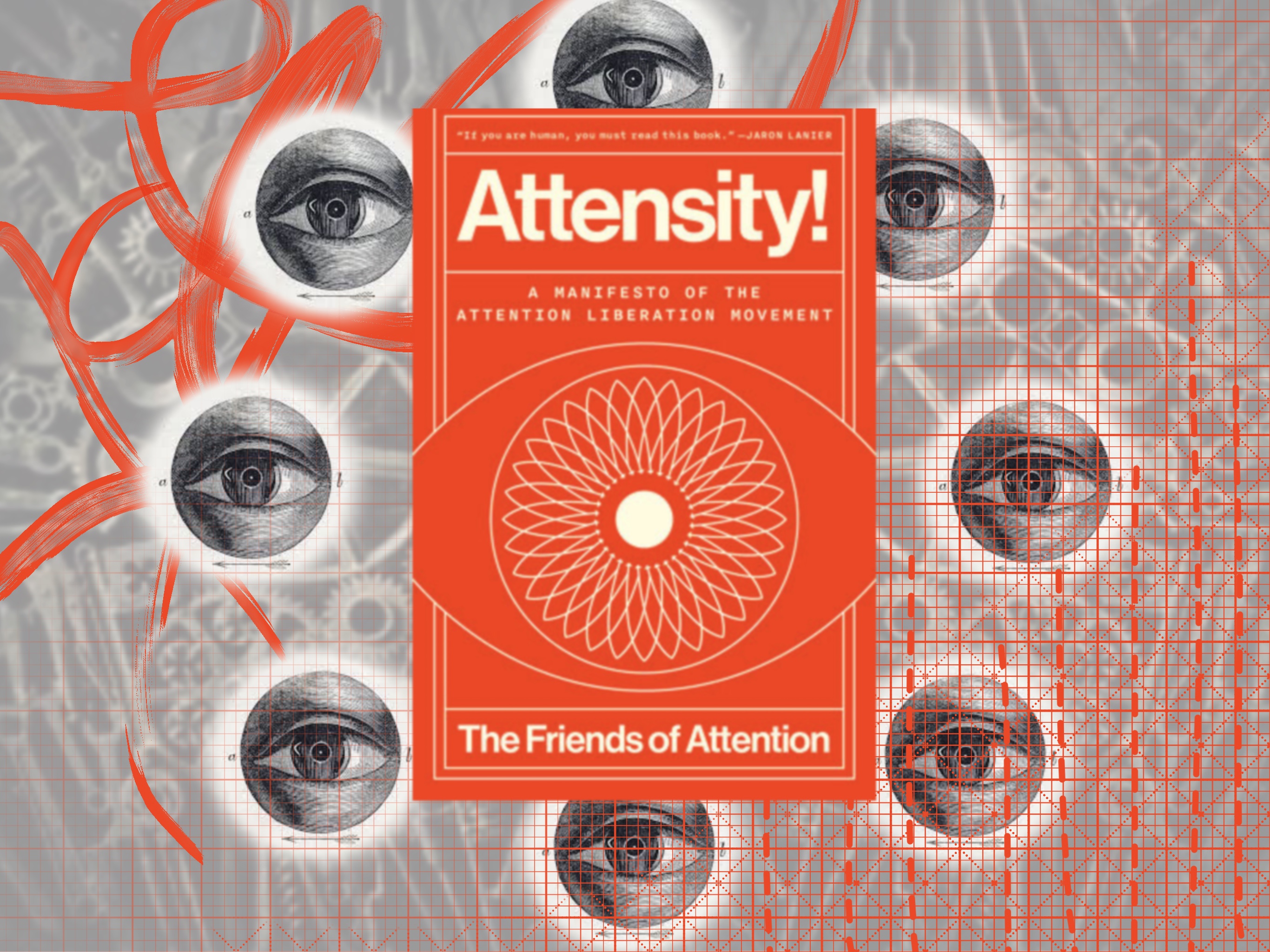
Attensity! The Manifesto of the Attention Liberation Movement. Edited by D. Graham Burnett, Alyssa Loh, and Peter Schmidt
Are you paying attention?
Attensity!, the manifesto of the Attention Liberation Movement, demands urgent address to what it deems the “key question of our moment”.
It asks us to re-consider the concept of attention: what attention is, how it’s being plundered by Big Tech, and what we might do to claim it back for ourselves.
The manifesto is the collective work of the Quaker-inspired Friends of Attention coalition, a group of self-defined Attention Activists. In it, they suggest that talking about attention must be “a conversation about coercion, theft, and the instrumentalization of human life”. They point out that there are plenty of parasitic entities ready to profit from our eyeballs, “needlessly pollut[ing] our inner environments in order to capture and sell as much of our attention as possible”. Throughout Attensity!, they highlights the wealth of evidence that tech companies, advertising industries, and the military are merrily harnessing invasive and destructive methods of “human fracking” to maximise wealth-creation. The online world is the site where much of this takes place: tech entrepreneurs provide “an ostensibly “free” digital universe – whose hidden operating cost is the depletion and pollution of the minds and senses of its users”. In the face of this, Attensity! argues, owning one’s attention is reclaiming one’s freedom.
It’s pretty hard to disagree with any of this, and it’s hardly controversial yet brave to say that our attention is being commodified and exploited near-constantly. We can feel it happening every time we get stuck in a doomscroll, or realise we’ve spent 90% of our waking hours any given day looking at a screen. When we feel foggy-brained and sick and annoyed at ourselves for spending so much time on our phones. When we bemoan our waning attention spans, or wonder if we’re suffering with undiagnosed ADHD. So to say Attensity! makes ‘compelling arguments’ would be to undersell it a bit. We all know, deep down, that we are being “bio-hacked at a societal scale”, and we know that it feels really bloody terrible.
Centrally, the book asks us to reconsider what we’ve been told ‘attention’ is, beyond simply the ability to focus on screen-based tasks – this limited definition “driven by a very specific Cold War thinking” – to incorporate interest, curiosity, our capacity to care, and spiritual transcendence. It calls for a fight not just for a ‘better attention span’ but for the freedom for a wider range of human experience.
Attensity! deliberately and repeatedly invites the reader to be an active part of the conversation, aided by the sense of collective created by the choral voice of the book. Clearly, many voices have been integrated into the writing, with changes in tone and prose styles across different sections.
It’s a convincing manifesto in that it resists despair and instead functions as a rousing call for change, discussing solutions including study, coalition-building, and the formation of sanctuaries. It looks back to the history of revolution and social/labour movements, finding examples of collective resistance for inspiration.
If you’re a human being existing in the modern world, I highly recommend picking up Attensity! and reading it start to finish. As a book, Attensity! is challenging, thought-provoking, and reflective – and as a manifesto, it’s a galvanising call for a revolution in attentional wellbeing.

 Emily Jessica Turner